Unlock the Fun and Challenge of Kakuro Puzzles with Part 05 of Our Activity Book
If you enjoy puzzles that make you think, stretch your brain, and deliver a genuine sense of accomplishment, then Kakuro deserves a spot on your radar. Often described as a perfect blend of crosswords and Sudoku, Kakuro offers a unique logic-number challenge that appeals to puzzle lovers of all backgrounds. With the release of Kakuro Puzzles Activity Book Part 05, we've packed even more mind-bending grids, clear solutions, and polished design into one accessible package. Whether you are a complete beginner or a seasoned solver, this guide will walk you through what Kakuro is, why it matters, how it benefits your brain, and why Part 05 of our activity book is an excellent choice for your next puzzle adventure.
What Exactly Is Kakuro? A Ground-Up Explanation
Kakuro is a logic puzzle that uses numbers instead of letters. You are given a grid with empty cells, and your task is to fill each row and column with digits from 1 to 9. The twist? Each row or column segment has a "clue" number at its start, and the digits you place must sum to that clue. No digit can repeat within a single sum. That means if a clue is 6 and you need two digits, you could use 1 and 5, or 2 and 4, but not 3 and 3 because repeats are not allowed.
Think of it as a mathematical crossword. Instead of vocabulary knowledge, you rely on addition and logical deduction. At first glance, a Kakuro grid can look intimidating — a mix of small and large cells with numbers in the borders. But once you understand the simple rule set, the puzzle opens up into a satisfying web of possibilities. You aren't guessing; you are reasoning your way to the only set of numbers that works.
Kakuro puzzles have been around for decades, originating in Japan under the name "Kakkuro" (a shortening of "kasan kurosu," meaning addition cross). They gained global popularity alongside Sudoku in the early 2000s. Their appeal lies in the pure logic required. There is no luck, no trick — just consistent, step-by-step thinking.
How Kakuro Differs from Sudoku and Crosswords
Many people compare Kakuro to Sudoku because both use numbers and grids. But the two puzzles are fundamentally different. In Sudoku, you fill every row, column, and box with digits 1 through 9 without repetition. In Kakuro, you only fill certain cells, and you use digits 1 through 9 but with a sum constraint. Sudoku relies on pattern recognition and elimination. Kakuro relies on addition combinations and cross-referencing clues.
Compared to crosswords, Kakuro swaps vocabulary for arithmetic. You don't need to know definitions or spellings. Instead, you need to know that a 3-cell sum of 7 can only be achieved with combinations like 1+2+4 or 1+3+3 (but 3+3 repeats, so it's invalid), so you must find the unique set that fits the crossing clues. This cross-referencing is what makes Kakuro so engaging — every number you place affects multiple sums, creating a web of logical interdependence.
For anyone who enjoys both words and numbers, Kakuro offers a refreshing middle ground. It challenges your numerical fluency without requiring advanced math. Basic addition up to 9 is all you need. The real difficulty comes from juggling possibilities and narrowing down options using logic.
The Cognitive Benefits of Solving Kakuro Puzzles
Puzzles are more than just entertainment. They are a form of mental exercise that keeps your brain agile. Kakuro, in particular, offers several cognitive benefits:
- Enhances working memory: You must hold possible number combinations in your mind while checking them against crossing clues. This strengthens your ability to manage multiple pieces of information at once.
- Improves logical reasoning: Every move in Kakuro is a deduction. You learn to think in terms of possibilities, constraints, and implications — skills that transfer to real-world problem-solving.
- Boosts concentration and focus: A Kakuro puzzle demands sustained attention. Distractions break the flow. Regular solving can help train your brain to stay on task.
- Builds number fluency: Working with sums from 3 to 45 (the maximum possible clue) and combinations of digits sharpens your mental arithmetic. You will start recognizing patterns like "3 cells that sum to 8 must be 1+2+5 or 1+3+4" without thinking twice.
- Provides a sense of accomplishment: Completing a tricky Kakuro grid releases dopamine, the brain's reward chemical. That feeling of "I solved it!" is both motivating and satisfying.
These benefits make Kakuro an excellent activity for people of all ages. Children can develop early number sense and logic skills. Adults can keep their minds sharp. Seniors can use puzzles as a tool for maintaining cognitive health. The beauty of Kakuro is that it scales with your ability — easier puzzles teach the fundamentals, and harder puzzles push your reasoning to the limit.
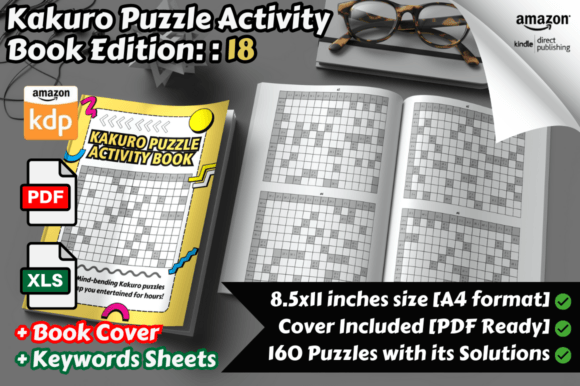
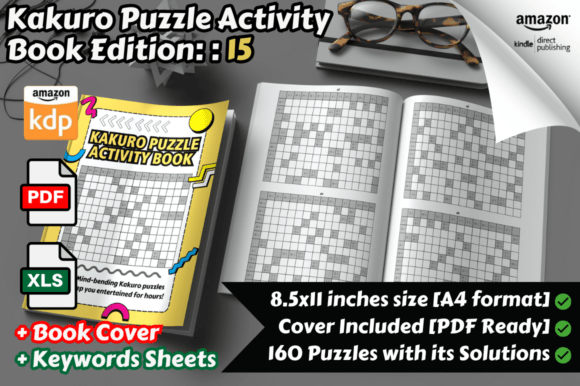
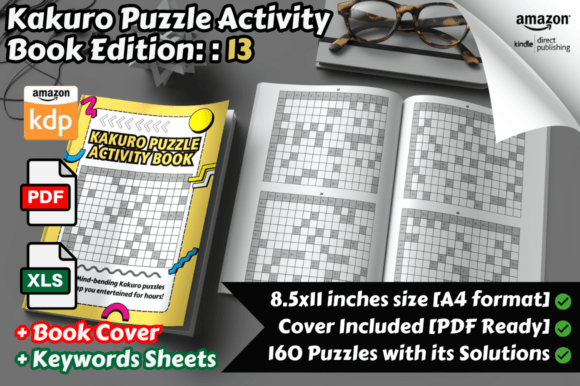
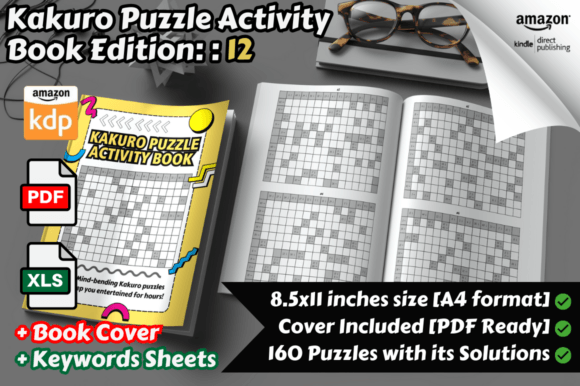
What's Inside the Kakuro Puzzles Activity Book Part 05
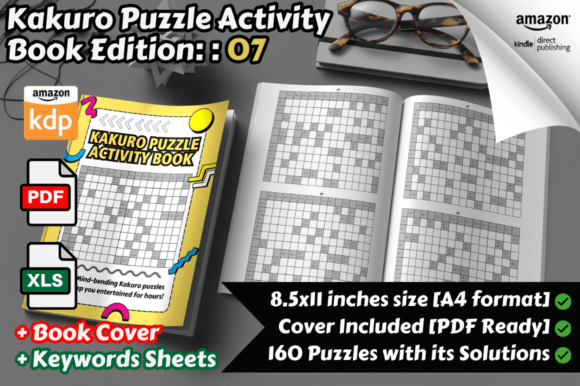
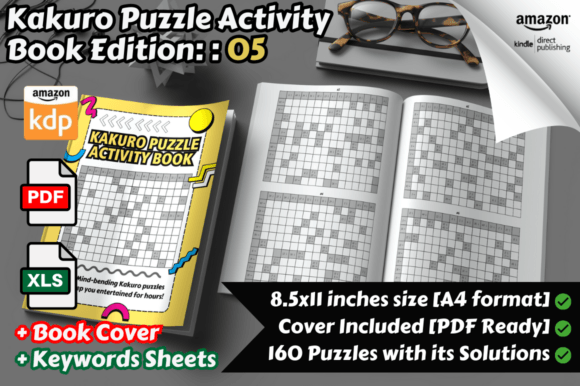
Our Kakuro Puzzles Activity Book Part 05 is designed to be your complete puzzle companion. Here is exactly what you get:
- 80 pages of mind-bending Kakuro puzzles — each puzzle is carefully crafted to provide a satisfying challenge. The difficulty progression is smooth, so you can warm up with easier grids before tackling the harder ones.
- 80 pages of solutions — every puzzle has a corresponding solution page. This makes it easy to check your answers, learn from mistakes, and track your progress. No more wondering if you got it right.
- Professionally designed 8.5x11 inch PDF interior file — the layout is clean, clear, and printed at a size that is comfortable for solving. Grids are large enough to write in, and the font is easy to read.
- Beautifully crafted PDF cover file — the cover is polished and attractive, ready for print or digital use. Whether you are creating a physical book or a digital download, the presentation is professional.
- Excel spreadsheet with a plethora of keywords — for those publishing or promoting the book, a keyword spreadsheet is included to help with discoverability and reach on platforms like Amazon or your own store.
This activity book is not just about puzzles. It's about creating a complete solving experience. Every element — from the puzzle design to the solution layout to the cover — is built with the solver in mind.
Who Can Enjoy This Activity Book?
One of the best things about Kakuro is its universal appeal. Part 05 of our activity book is suitable for:
- Beginners who have never solved Kakuro before. The early puzzles are gentle introductions. You can learn the rules and build confidence step by step.
- Intermediate solvers looking for consistent practice. The book offers dozens of puzzles at a moderate difficulty level to help you refine your techniques.
- Advanced puzzlers who want a challenge. The later puzzles in the book will test your logic and patience. If you can complete them all, you can call yourself a true Kakuro enthusiast.
- Families and groups who enjoy solving together. Kakuro is a great activity for family game night, friendly competitions, or collaborative problem-solving. Work through a puzzle as a team, or race to see who finishes first.
- Teachers and educators who want to incorporate logic and math puzzles into their lessons. Kakuro reinforces addition, logical thinking, and systematic reasoning in a fun, engaging way.
- Anyone looking for a screen-free brain workout that is portable and easy to pick up. Print the pages, grab a pencil, and you are ready to go.
Kakuro is not age-restricted. Children as young as 8 or 9 can solve simple Kakuro puzzles with guidance, and adults of any age can enjoy the mental stimulation. The activity book format makes it easy to carry a few pages in a bag or keep the whole book on a desk for daily solving.
Tips for Solving Kakuro Puzzles — Especially for Beginners
If you are new to Kakuro, the first grid might look confusing. Here are some practical tips to get started:
- Learn the clue notation: In Kakuro, clues are written in the diagonal cells. The number above the diagonal is the clue for the cells to the right (across). The number below the diagonal is the clue for the cells downward (down). Understand this orientation first.
- Start with small sums: Look for clues that have only one or two possible digit combinations. For example, a 2-cell sum of 3 can only be 1+2. A 2-cell sum of 4 can only be 1+3 (since 2+2 repeats). These "unique" combinations are your footholds.
- Use pencil and eraser: Kakuro involves trial and error. Write small possible numbers in the corners of cells. As you deduce, erase the ones that become impossible. This keeps your grid clean and your thinking clear.
- Cross-reference constantly: Every number you place affects both an across sum and a down sum. After placing a digit, immediately check which crossing clues are impacted. This is where the real logic happens.
- Watch for repetition: Remember, digits cannot repeat within a sum. This is often the key to eliminating possibilities. If a row has two cells that sum to 6, and one cell is already 3, the other cannot also be 3. It must be 1+5 or 2+4, adjusted for crossing constraints.
- Practice with easier puzzles first: Our activity book starts with simpler grids. Use them to internalize the logic. Speed comes with time. Accuracy matters more than speed.
- Don't be afraid to backtrack: If you get stuck, you might have placed a number incorrectly. Go back to the last point where you were certain, and re-evaluate. This is part of the learning process.
Once you solve your first puzzle, you will likely feel that "click" of understanding. From there, each puzzle becomes more intuitive. Many solvers develop their own shorthand — marking possible sums, using dots or lines to track options, or solving in a specific order. Find what works for you.
Why Kakuro Fits Perfectly into Modern Life
In a world full of fast-paced digital distractions, puzzles like Kakuro offer a valuable counterbalance. They demand focused, quiet thinking. They are a form of mindful engagement that pulls you away from screens and into a state of flow. A single Kakuro puzzle can take anywhere from 10 minutes to an hour, depending on difficulty. That makes it perfect for a coffee break, a commute, or a wind-down activity before bed.
Kakuro also fits into the growing trend of brain training and lifelong learning. People are increasingly looking for ways to keep their minds sharp as they age. Puzzles like Kakuro are backed by neuroscience as one type of cognitive stimulation that may help maintain mental agility. While no single activity guarantees brain health, variety and challenge are key — and Kakuro provides both.
For educators, Kakuro is a powerful tool for teaching number combinations, logical deduction, and systematic thinking. Unlike rote drills, puzzles feel like a game. Students engage because they want to solve the puzzle, not because they are told to practice addition. The learning happens naturally, embedded in the fun.
For families, Kakuro can be a bonding activity. Parents and children can solve together, taking turns placing numbers or discussing possibilities. It teaches patience, collaboration, and perseverance. When you solve a tough puzzle as a team, you share the victory.
For individuals, Kakuro is a personal challenge. It is you against the grid. There is no timer, no competition unless you want one. You set the pace. You choose the difficulty. You experience the satisfaction of cracking the logic.
Common Misunderstandings About Kakuro — Clarified
Because Kakuro is less widely known than Sudoku or crosswords, a few misconceptions sometimes arise. Let me clear them up:
- "I need to be good at math." No. You only need to add numbers from 1 to 9. That's elementary arithmetic. The challenge is logic, not calculation.
- "It's just like Sudoku." As discussed, the mechanics are different. Sudoku uses all digits 1-9 in every row/column/box. Kakuro uses sums and no repeats within a sum. The solving strategies overlap only slightly.
- "The grid is too confusing." The first look can be intimidating, but once you learn the clue placement (across and down), it becomes intuitive. Start with an easy puzzle and the layout will make sense quickly.
- "I'll get stuck and not be able to finish." Every puzzle in our activity book has a solution. If you get stuck, you can look at the answer and trace back the logic. That's how you learn. Over time, you'll rely on the solutions less and less.
- "It's only for old people." Not at all. Puzzle enthusiasts span all ages. Kids enjoy the number play, adults enjoy the mental challenge, and seniors enjoy the cognitive workout. Kakuro is for everyone.
Ready to Dive In? The Bigger Picture
The Kakuro Puzzles Activity Book Part 05 is more than a collection of puzzles. It is an invitation to engage your mind in a rewarding, screen-free activity that builds skills, confidence, and joy. Whether you are buying it for yourself, as a gift for a puzzle-loving friend, or as a resource for a classroom, you are investing in quality brain time.
Kakuro has stood the test of time because it works. It challenges you just enough to keep you interested. It rewards persistence and clear thinking. And every solved puzzle leaves you feeling a little sharper than before.
So grab a pencil, open the book, and start with puzzle one. The combinations are waiting. The clues are set. Your brain is ready. Let the solving begin.
Remember: Every number you place is a step toward mastery. Enjoy the process, celebrate the small victories, and don't be afraid to make mistakes — that is how we learn. Happy puzzling!