Math Activity Book for Kids V-5
A well-structured math workbook can transform how a child experiences numbers. Rather than presenting abstract problems on a page, a thoughtfully designed activity book turns each concept into a small discovery. Math Activity Book for Kids V-5 does exactly that. It offers a printable, fully editable resource that moves beyond rote practice and invites children to engage with counting, addition, subtraction, and number sense through varied, hands-on activities. For creators, educators, and small business owners, this book represents more than a teaching tool — it is a flexible template that can be adapted, rebranded, or customized for different learning environments.
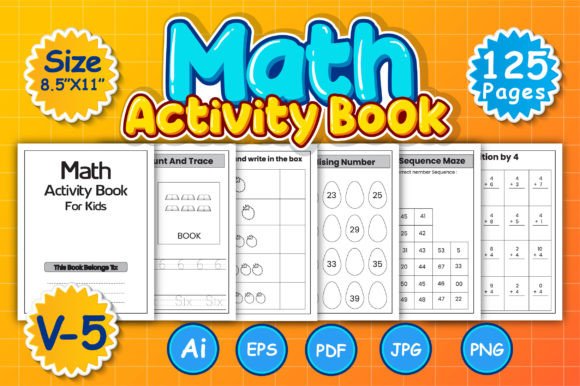
What makes this volume particularly useful is its structure. With 125 pages of content, it covers foundational math skills in a logical sequence while keeping each page visually inviting and task-focused. The activities start simply — introducing numbers and counting — then build toward matching, addition, and subtraction with objects. This progression mirrors how young learners naturally develop numerical understanding, making the book suitable for preschool through early elementary use.
What the Activity Book Offers
The book is organized into eleven distinct sections, each targeting a specific skill. The opening section, Introduction With Number, familiarizes children with digits and their names. From there, Counting and Writing in Box encourages them to practice numeral formation within guided spaces — a small detail that supports handwriting and spatial awareness simultaneously.
Other sections like Fill the Rising Number and Number Maze introduce sequencing and logical thinking in a game-like format. Addition With and Subtraction present basic operations, while their object-based counterparts — Addition with Objects and Subtraction with Objects — allow children to visualize quantities before calculating. Activities such as Number Matching, Number Matching with Objects, and Circle the correct Number reinforce one-to-one correspondence and comparison skills.
The file package includes high-resolution AI, EPS, PNG, JPG, and PDF formats, all sized at 8.5″ x 11″ with no bleed and ready for print. This means you can open the files in Adobe Illustrator or a compatible editor, modify text, swap images, adjust colors, and republish without worrying about layout constraints. For anyone creating educational content, this level of editability is a significant time-saver.
Who Benefits from This Resource
While the end user is a child learning math, the direct audience for this product includes adults who produce or select learning materials. If you are a teacher building a classroom workbook, a homeschool parent assembling a curriculum, a freelance designer looking for a print-ready project, or a small publisher expanding your catalog, this book gives you a strong starting point.
For educators, the variety of activity types means you can differentiate instruction within a single classroom. Some children will gravitate toward number mazes, while others gain confidence from matching exercises. Having all 11 sections in one book allows you to pick and choose pages that match each student’s readiness level.
Graphic designers and sellers on platforms like Amazon KDP or Etsy can use the editable files to rebrand the workbook under their own store name. Changing the cover, adjusting the font, or adding your logo takes minimal effort because the source files are layered and well-organized. The no-bleed setup also simplifies print-on-demand production, reducing the risk of trimming errors.
Homeschooling parents will appreciate the self-contained format. Instead of hunting for worksheets across multiple websites, you get 125 pages of consistent, age-appropriate material. You can print only the pages your child needs at a given time, or bind the whole book for a semester-long resource.
Creative Ways to Adapt and Extend the Content
One of the strongest features of this activity book is how easily it can be customized. Because the files are fully editable, you are not limited to using them as-is. Here are several approaches to expand or repurpose the material.
Customize the Visual Style
The original design uses clean layouts that work well for most audiences. But you can change the color palette to match a brand, add themed illustrations (animals, space, or underwater scenes), or adjust the font to suit different age groups. A younger audience might benefit from larger numerals and more spacious boxes, while an older group could handle denser pages with smaller print. The editable AI and EPS files make these adjustments straightforward.
Create a Digital or Interactive Version
With the PNG and JPG files, you can import individual pages into apps like Procreate, GoodNotes, or Canva and add interactive elements. For example, a page from Number Maze could become a touch-based tracing activity on a tablet. You could also convert selected pages into fillable PDFs for distance learning, allowing students to type answers directly into boxes. This extends the book’s utility beyond print-only contexts.
Combine Sections into Themed Mini-Books
Instead of offering the entire 125-page book, you could break it into smaller volumes focused on specific skills. A “Counting and Writing” mini-book might include pages from sections 1, 2, and 4. An “Addition and Subtraction” mini-book could pull from sections 5, 6, 8, 9, and 10. This modular approach lets you sell individual titles at a lower price point, appealing to customers who want targeted practice rather than a comprehensive workbook.
Translate or Localize the Content
Since the text in the AI and EPS files is editable, translating the book into another language is a realistic project. You could produce Spanish, French, or bilingual versions for specific markets. The activity types — matching, mazes, circling answers — rely more on visuals than on language, so the translation work focuses mainly on instructions and number names. This makes localization faster than creating new content from scratch.
Use as a Template for Original Workbooks
The structure of this book can serve as a blueprint for designing your own activity books on other topics. Notice how each section builds on the previous one, how instructions remain concise, and how white space is used to avoid overwhelming the learner. Study the layout choices — box sizes, placement of number lines, use of objects for counting — and apply similar principles to workbooks for phonics, shapes, or even early science concepts. You are essentially getting a proven format that you can replicate across multiple subjects.
Practical Tips for Printing and Publishing
Whether you are printing a single copy for your child or preparing a batch for sale, the technical details matter. The files come with no bleed, which means the content stays within the page boundaries without extending past the trim line. This is ideal for print-on-demand services because you do not need to adjust margins manually. Just upload the PDF as-is, and the printer will handle the rest.
If you plan to bind the book yourself, consider using a coil or comb binding so the pages lie flat. Young children often press down hard when writing, so flat pages reduce frustration. For digital distribution, save individual sections as separate PDFs so users can print only what they need.
When selling on marketplaces, include sample pages that showcase the variety of activities. Show one page from Number Maze, one from Addition with Objects, and one from Circle the correct Number. This demonstrates the range of difficulty and format, helping buyers see that the book offers more than just repetitive drills.
Maintaining Quality and Consistency
Even with an editable file, keeping the workbook visually consistent across all 125 pages requires attention. Choose a limited color palette — two or three main colors plus an accent — and apply it throughout. If you replace images, ensure they share a similar illustration style. Mixing cartoon characters with realistic photography can distract the learner and make the book feel disjointed.
Check that instructions remain clear and uniform. For example, if you modify the wording on one page, apply the same phrasing to similar pages. Consistency builds familiarity, which helps children focus on the math rather than deciphering new directions each time.
Test the file formats before publishing. Open the AI and EPS files in your software of choice to confirm that layers are intact and text is editable. Export a test PDF and print a few pages to check alignment, font rendering, and image quality. Catching issues early prevents larger problems during production.
Realistic Applications for Different Settings
In a classroom, a teacher might print the Fill the Rising Number and Number Maze pages for a math center, while sending Counting and Writing in Box home as homework. The variety allows one book to serve multiple purposes without requiring additional resources.
A freelance designer could take the editable files and create a branded version for a local preschool or tutoring center. Adding the school’s logo, using its brand colors, and printing a classroom set positions the designer as a valuable partner rather than just a content seller.
For a small business owner on Etsy, bundling this workbook with complementary items — like a set of counting flashcards or a number tracing poster — increases the perceived value. Customers looking for a complete early math solution are more likely to purchase a bundle than a single item.
Even a parent who simply wants to support their child’s learning at home can benefit from the book’s structure. Instead of searching for worksheets every week, you have a ready-made progression that covers an entire school year. Print a few pages each week, and your child builds skills gradually without pressure.
Final Considerations
Math Activity Book for Kids V-5 occupies a useful middle ground. It is detailed enough to serve as a complete workbook, yet flexible enough to be a starting point for customization. The 125-page length gives substantial value, while the editable file formats remove technical barriers for creators and educators.
Whether you plan to print it for personal use, adapt it for a specific audience, or republish it under your own brand, the key is to treat the book as a resource that can be shaped to fit your context. The activities themselves are sound — grounded in early math learning principles — and the format is production-ready. Your main task is to decide how to present, combine, or extend them in a way that meets your learners’ needs.
By focusing on the practical details — consistent design, clear instructions, appropriate file formats — you turn a good activity book into a reliable tool that children actually enjoy using. And that is the real goal: not just filling in boxes, but building confidence with numbers, one page at a time.